
Accessibility and Universal Design in Engineering Curriculum (2017)

Proceedings of the April 2017 AccessEngineering Capacity Building Institute (CBI)
This publication shares the proceedings of the capacity building institute (CBI) entitled Accessibility and Universal Design in Engineering Curriculum that took place in Seattle, Washington in April of 2017. The content may be useful for people who
- participated in the CBI;
- seek to increase their understanding of issues surrounding the participation of students with disabilities in engineering studies and careers;
- are interested in integrating information related to disability, accessibility, and universal design into engineering courses;
- would like to access resources to help make their courses, services, and activities more welcoming and accessible to students with disabilities; and
- have promising practices to share with others.
About AccessEngineering
AccessEngineering works to increase the participation of people with disabilities in education and careers in engineering and improve engineering fields with their perspectives and expertise. Central to this work is a leadership team of faculty members from colleges and universities across the country. AccessEngineering is led by the College of Engineering and the DO-IT (Disabilities, Opportunities, Internetworking, and Technology) Center at the University of Washington (UW) and is funded by the National Science Foundation (Grant #EEC-1444961).
AccessEngineering builds on theory, research, and practice to address immediate challenges facing engineering education today, including increasing the size of the engineering workforce, diversifying engineering fields, and meeting institutional obligations under the Americans with Disabilities Act of 1990 and its 2008 amendments. The project focuses on two objectives:
- Better serving a diverse student body that includes students with disabilities in engineering courses and programs
- Integrating relevant disability-related and universal design content into engineering courses
This second objective is an opportunity to improve engineering education as a whole and could lead to the development of more accessible technology by the next generation of professional engineers, while including information in the engineering curriculum that may be of particular interest to potential engineering students, including students with disabilities.
About the CBI
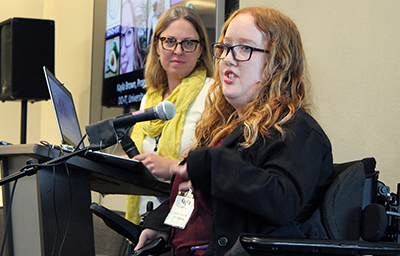
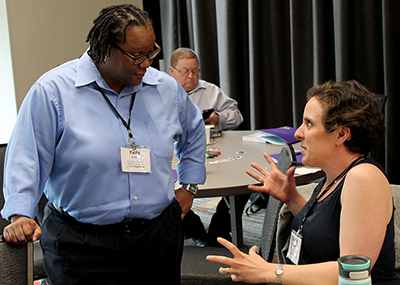
Accessibility and Universal Design in Engineering Curriculum, sponsored by AccessEngineering, was held in Seattle, WA on April 19–21, 2017. Its purpose was to encourage efforts to make engineering more welcoming and accessible to students with disabilities and enhance engineering curricula with disability-related and universal design topics. Attendees included engineering students and professionals with disabilities, postsecondary faculty and administrators, disability experts, and professional organization representatives.
This CBI featured the following:
- All participants contributed to its success.
- Speakers participated in group discussions.
- Experts in all topic areas were in the audience.
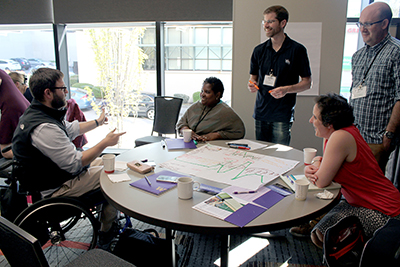
- Participants gave presentations and participated in small and large group discussions.
- Some predetermined professional development was presented, new content was delivered as the meeting unfolded, participant interests were expressed, and expertise was made known.
The CBI provided a forum for discussing recruitment and access challenges, sharing expertise and successful practices, developing collaborations, creating resources, and identifying systemic change initiatives relevant to the meeting goals.
Topics discussed included
- universal design of laboratories, instruction, and academic accommodations;
- the experiences of engineering students and professionals with disabilities;
- outreach activities designed to recruit students with disabilities into engineering;
- best practices for making courses welcoming and accessible to students with disabilities; and
- inclusion of disability, accessibility, and universal design topics in engineering curricula.
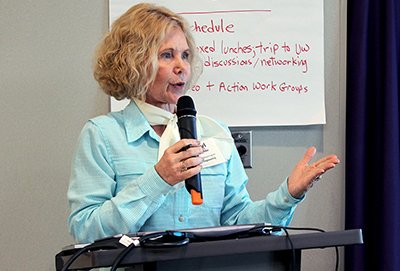
The agenda for the CBI and summaries of the presentations, panels, and working group discussions are provided on the following pages.
CBI Agenda
Wednesday, April 19th
7:00 – 9:00 pm
Networking Reception
Thursday, April 20th
8:00 – 9:00 am
Breakfast and Networking
9:00 – 10:00
Welcome, Overview, and Introductions
Sheryl Burgstahler, Katherine Steele, and Maya Cakmak, University of Washington
Why are disability and accessibility important for engineering? What are frameworks to train engineers in these topics?
10:00 – 11:00
Unpacking What We Know About Disability and Accessibility
Heather Feldner, Ability & Innovation Lab, and Kayla Brown, AccessEngineering
11:00 – 11:15
Break
11:15 – 12:15
Panel of Engineering Students and Professionals with Disabilities
Panelists: Cindy Bennett, University of Washington; Matthew Mack, Microsoft; Michael Villanueva, Boeing
Moderator: Kayla Brown, University of Washington
12:15 – 1:15
Working Lunch (Formation of Action Groups)
1:15 – 2:15
Keynote — Designing for People: Nine Random Topics
Dan Formosa, Dan Formosa, Inc.
2:15 – 2:30
Break
2:30 – 3:30
CBI Participant Presentations
Design thinking: Kristen Shinohara, University of Washington; Universal design in digital media: Howard Kramer & Elianna James, University of Colorado - Boulder; Universal design in capstone design: Jered Dean, Colorado School of Mines; Introducing universal design in a bioengineering capstone: Alyssa Taylor, University of Washington
3:30 – 4:30
Action Group Work Time
What do you want to take back to your classes or institution?
Groups will define their goals and deliverables for tomorrow.
4:30 – 5:00
Preview of Tomorrow’s Topics
Complete Daily Feedback Form
Pose for Group Picture
Friday, April 21st
8:00 – 9:00 am
Breakfast and Networking
9:00 – 9:15
Daily Overview
9:15 – 11:15
Workshop - Design Physics: Relationships
Dan Formosa, Dan Formosa, Inc.
11:15-11:30
Break
11:30-12:00
Report Out
12:00 – 1:00
Lunch, Networking and Discussion
Discussion: What are excellent examples of UD for engineers? What should every engineer know about UD? What types of materials are needed to integrate UD into engineering curriculum?
1:00-1:15
Report Out from Lunch Discussion
1:15 -2:30
Action Group Work Time
Individually or in groups, discuss and create actionable tools for implementing the interventions we have discussed. Examples: Checklists, assignments, guidelines, activities.
2:30 – 2:45
Break
2:45 – 3:15
Report Out from Working Groups
3:15 – 4:15
Participant Presentations: Participatory Design and Engagement
Diversity and inclusion in the classroom: Kelly Cross, University of Illinois Urbana-Champaign; Opportunities and pitfalls in project-based at courses: Jeff Dusek, Olin College; iDesignLabs for co-design with community: Anat Caspi, University of Washington; Universal design and geopolitics: Zaza Kabayadondo, Smith College
4:15 – 4:30
AccessEngineering Resources and Continuing Activities
Evaluation
Pre- and Post-Survey Results
Before and after the CBI, surveys were distributed to participants to learn more about their experiences with disability and universal design. Some responses to select questions are included below.
In the pre-CBI survey, most participants indicated that they had not been exposed to accessibility or disability in their engineering education. Responses to other pre-CBI survey questions are below.
How would you define universal design?
- Universal design guides the design of products and environments to be as accessible and inclusive of all people, to the greatest extent possible.
- Universal designs serve not only one population but the entire population.
- Universal design considers the actual users of what is being designed, instead of a hypothetical user who tends to look much like the stereotypical design engineer (white, male, and nondisabled). It questions how space/materials/items could be used to understand user experiences beyond a single case scenario
- Universal design solutions consider all users
- In my mind, universal design is an approach that recognizes the diversity of human experience and the importance of being aware of it and benefitting from it in the design process.
What is an excellent example of universal design?
- OXO Kitchen Tools are very universally designed.
- Curb cuts are usually my go-to example of a great universal design feature. Yes they provide increased accessibility for wheelchair users, but they also are great for individuals with strollers or carts, wheeled luggage, bikes, etc.
- Captioning online lectures is not only useful for Deaf students, but for those who might have difficult understanding accents, are taking a course in their non-native language, for someone who needs to access the material in a quiet location without disturbing others, or for someone whose audio isn’t working for whatever reason.
- Crosswalks are much more accessible when they have the rumble strip and voice prompts.
- Amazon’s Alexa reaches a wider audience by using voice commands to perform interactive and flexible tasks.
- Motion activated paper towel dispensers
- iPhone has built in customization for the range of input and output preferences from blindness to low vision to poor dexterity.
- Keyless door locks could offer a great universal design option.
- I was at a newer hotel recently that had their room numbers posted on a small plaque about halfway down next to the door. There were numbers, a different but common image for each room on the floor, like an apple or a bicycle, and it had braille numbers. It struck me as very inclusive in both physical and sensory ways.
- International airports must be prepared to efficiently serve people of all different backgrounds and abilities.
- Automatic sliding doors are accessible because when people approach, they open automatically.
What should all engineers be taught about universal design?
- A framework for small design tweaks that improve inclusivity
- Why universal design is important and how it can help more than “just” marginalized groups of people
- How to frame the scope of the problem. This is where most engineers miss the opportunity to create something while being critically conscious about their designs. It is important to know the client and the needs of the client
- Instead of thinking in terms of taking an existing design/product/app and modifying it to be more accessible, think of accessibility as an inherent part of the initial design process
- That their duty is to society and that doesn’t just mean “the average user”
- Designing for disability can lead to innovations that become better for everyone
- Universal design is not something you tack on at the end of a project—it’s a way of thinking and approaching a problem
- That UD is an extension of usability, which every engineer should be concerned with—UD just considers a wider population than usually addressed under usability
What should all engineers be taught about disability?
- Awareness and exposure to diversity of human experiences
- Disability isn’t innately a bad thing
- People have varying abilities, and that many people with disabilities don’t want to be “fixed”
- The physical or mental limitations should not disqualify people from the field of engineering
- The diversity of abilities and perspectives help us design more complete, robust and holistic solutions or designs
- Engineers should be exposed to varying models of disability, including that disability is a part of diversity
How have you taught students about disability or universal design?
- I teach them that design is for the inclusion of all customers.
- I teach my students about social justice in the context of engineering. It doesn’t address universal design specifically, but the intent of the course is to help students develop a critical consciousness.
- I present UD as an ethical issue related to design, and also an issue of potential design failures.
- We ask students to critique their designs’ social impact.
- I hope that I teach them everyday just by showing up in my wheelchair ready to work hard for them and for my school.
After the CBI, responses to the post-survey included the following:
How did your definition of universal design change as a result of attending the CBI?
- I realized that we need to be doing more to consider what universal design means when considering invisible disabilities. It’s easy to recognize changes that promote accessibility in physical and digital spaces that correlate to specific needs (e.g., ramps or color contrast) that reflect “understood” disabilities. It’s a lot less obvious what “universal design” means when discussing things related to processing information, memory, and organizational needs.
- I think I started to see the benefits of designing systems on a much broader spectrum rather than trying to “eat at” the overall problem of universal design through solving one underrepresented group’s needs at a time.
- It skewed towards inclusivity. That was part of my thought pattern before but the conference solidified it. Also I realized that, in our rush to id solutions we frequently don’t take enough time to think it through completely.
- I recognized that it’s not only about helping people with disabilities—universal design ends up helping most people.
What are additional examples of universal design?
- Name tag that considers various peoples’ need
- flexible work schedules, including flexible tenure schedules
- I would say spectacles, and no-hassle packaging (now an option when you shop on amazon)
- Touch faucets
- Table with adjustable heights
What should all engineers be taught about universal design?
- Engineers should design products that considered different individuals’ needs.
- Using simulation exercises does not stimulate empathy, but rather sympathy or pity.
- Do not think of average users; a wider range of users creates better more realistic.
- Design should be to the margins rather than the average.
- That it is a key part of good design.
- The input of individuals with disabilities must be integrated into the development of universally designed products and environments.
What should all faculty be taught about these topics?
- What can faculty do to accommodate
- Disability is part of diversity
- Limitations exist on a spectrum. Disability is not just reflective of these limitations, but is an identity as well
- How to include UD into project design
- Making your course more accessible doesn’t make it easy, just includes better practices.
Presentation Summaries
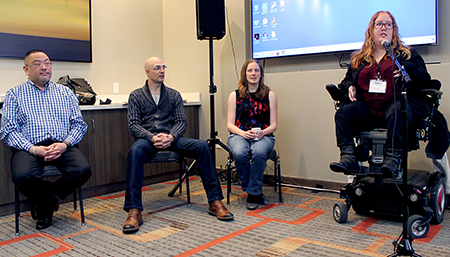
Panel of Engineering Students and Professionals with Disabilities
Panelists included Cindy Bennett, University of Washington; Matthew Mack, Microsoft; and Michael Villanueva, Boeing.
In your education or career, how have you seen disability been integrated into engineering? Or where did you notice it missing?
- Emphasizing the importance of accessibility. My company has been strong in accessibility, though we have had challenges. How do we ensure our teams address accessibility in every product? It can sometimes be a complete blind spot. Accessibility isn’t mainstream – most people don’t have experience with accessibility. Assistive technology needs to be taught at the educational level.
- When designing new products, unless there is a person with a disability or who has been trained in accessibility, accessibility is often not considered. Can we all be trained in empathy for a variety of users?
- Even in an environment focused on diversity, disability is still often forgotten and ignored. There needs to be more visibility of disability, including more students and more faculty with disabilities. Empathy requires establishing a rapport with people with disabilities—a one off meeting won’t necessarily make a student remember to include disability, but making a relationship with someone with a disability might.
- Accessibility should be taught in all classes. Accessibility should be required to be included in projects and all classes.
Do you use accommodations? What are those accommodations?
- I use a few different screen readers, and I also read braille in print and on a braille display. I also sometimes use a human assistant, for example, to make sure I format my PowerPoint slides correctly.
- I don’t want an interpreter—I just wanted to be included. I usually Skype into meetings, so I can turn the volume up.
What is a faculty member’s role in accommodations?
- I sometimes go without if I don’t want to jump through the hoops to get my accommodations. Some students may not know what they need. As a faculty member, when you get a letter about a student’s accommodations, start a conversation with the student. Working together to find solutions will help the student be successful.
- Students don’t want to stand out or feel different. Make a statement about disability as a part of diversity. Teach in as accessible manner. If you can make it easier for a person with a disability, it’s only going to make it better for everyone else in the class as well.
- Faculty should act as mentors and advocates. Familiarize yourself with existing resources and advocate for additional resources as needed.
- Accessibility shouldn’t be seen as a burden. Students should be able to work towards their full potential rather than spending their time solving accessibility problems. Faculty should work to make sure students aren’t confronting roadblocks.
- Some faculty think industry won’t provide disability-related accommodations to employees. In reality, this isn’t true and many companies value employees with disabilities. Faculty need to know this.
- I worked hard and yet I wasn’t encouraged to pursue engineering. If I had listened, I wouldn’t be where I am today and my company would be worse off. Faculty should be encouraging their students and thinking globally about how to include diversity.
How do you quickly give someone the skills to solve a problem, especially concerning accessibility?
- Disability is still a niche—students are not thinking about accessibility. Faculty can give students the tools to address accessibility issues. Normalize the practice of accessibility.
- We need to stop telling people that accessibility is hard, because the mindset should be that accessibility is easy.
Accommodations can often be seen as giving someone with a disability an unfair advantage. How can we promote the idea that accommodations merely level the playing field?
- Provide training in unconscious bias. Explain how accommodations create access. People with disabilities just want equal access.
- Accommodations can then be seen as a handout, when they aren’t—they are just creating an environment where everyone can engage.
- I don’t have the ability to work at a physically-demanding job; my most valuable asset is my mind. STEM education allows me to use my mind to be a productive member of society.
Panel Summaries
Panel of Engineering Students and Professionals with Disabilities
Panelists included Cindy Bennett, University of Washington; Matthew Mack, Microsoft; and Michael Villanueva, Boeing.
In your education or career, how have you seen disability been integrated into engineering? Or where did you notice it missing?
- Emphasizing the importance of accessibility. My company has been strong in accessibility, though we have had challenges. How do we ensure our teams address accessibility in every product? It can sometimes be a complete blind spot. Accessibility isn’t mainstream – most people don’t have experience with accessibility. Assistive technology needs to be taught at the educational level.
- When designing new products, unless there is a person with a disability or who has been trained in accessibility, accessibility is often not considered. Can we all be trained in empathy for a variety of users?
- Even in an environment focused on diversity, disability is still often forgotten and ignored. There needs to be more visibility of disability, including more students and more faculty with disabilities. Empathy requires establishing a rapport with people with disabilities—a one off meeting won’t necessarily make a student remember to include disability, but making a relationship with someone with a disability might.
- Accessibility should be taught in all classes. Accessibility should be required to be included in projects and all classes.
Do you use accommodations? What are those accommodations?
- I use a few different screen readers, and I also read braille in print and on a braille display. I also sometimes use a human assistant, for example, to make sure I format my PowerPoint slides correctly.
- I don’t want an interpreter—I just wanted to be included. I usually Skype into meetings, so I can turn the volume up.
What is a faculty member’s role in accommodations?
- I sometimes go without if I don’t want to jump through the hoops to get my accommodations. Some students may not know what they need. As a faculty member, when you get a letter about a student’s accommodations, start a conversation with the student. Working together to find solutions will help the student be successful.
- Students don’t want to stand out or feel different. Make a statement about disability as a part of diversity. Teach in as accessible manner. If you can make it easier for a person with a disability, it’s only going to make it better for everyone else in the class as well.
- Faculty should act as mentors and advocates. Familiarize yourself with existing resources and advocate for additional resources as needed.
- Accessibility shouldn’t be seen as a burden. Students should be able to work towards their full potential rather than spending their time solving accessibility problems. Faculty should work to make sure students aren’t confronting roadblocks.
- Some faculty think industry won’t provide disability-related accommodations to employees. In reality, this isn’t true and many companies value employees with disabilities. Faculty need to know this.
- I worked hard and yet I wasn’t encouraged to pursue engineering. If I had listened, I wouldn’t be where I am today and my company would be worse off. Faculty should be encouraging their students and thinking globally about how to include diversity.
How do you quickly give someone the skills to solve a problem, especially concerning accessibility?
- Disability is still a niche—students are not thinking about accessibility. Faculty can give students the tools to address accessibility issues. Normalize the practice of accessibility.
- We need to stop telling people that accessibility is hard, because the mindset should be that accessibility is easy.
Accommodations can often be seen as giving someone with a disability an unfair advantage. How can we promote the idea that accommodations merely level the playing field?
- Provide training in unconscious bias. Explain how accommodations create access. People with disabilities just want equal access.
- Accommodations can then be seen as a handout, when they aren’t—they are just creating an environment where everyone can engage.
- I don’t have the ability to work at a physically-demanding job; my most valuable asset is my mind. STEM education allows me to use my mind to be a productive member of society.
Working Group Summaries
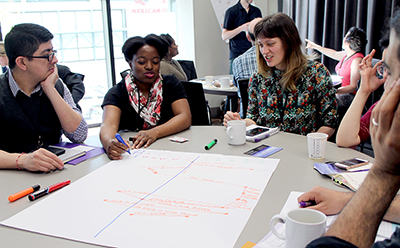
During the CBI participants worked in groups to address issues related to increasing the participation of people with disabilities in engineering and including information related to UD in the curriculum. Ideas that were generated include the following:
Strategies for teaching faculty or students about UD or disability
- There are a variety of ways to give students or faculty a taste of UD or disability. Similar strategies can be used for both groups. These activities could be integrated into a course or done at a faculty meeting:
- Create and distribute a slide deck used throughout the department
- Develop an assessment tool for teaching UD
- Invite guest lecturers
- Host a panel of students
- Consider how UD addresses ABET requirements
- Utilize case studies to demonstrate the benefits of UD
- Use practical experiences instead of simulation exercises, which can have negative effects
- Use a screen reader and showcase accessible verse inaccessible websites
- Plan a faculty inquiry group to learn about UD. Over a series of meetings, self-selected participants would form a community and learn about disability and accessibility together. Potential meeting topics could include
- “Disability 101,” including history, rhetoric, and social issues,
- A panel of students with disabilities,
- Universal design practice, including technology and other issues, and
- Campus resources and more discussion of changes that could be made.
- Consider UD in a context other than accessibility. Use a 90-minute class period to discuss space travel. You’re going to Mars, and there is a leak in your spacecraft. The person on the inside of the spacecraft is going to start dealing with hypoxia, and the person on the outside has a spacesuit. What would you do to help the astronauts solve this conundrum, and then what best practices would you include in designing a spacecraft for someone with hypoxia (loss of good vision, motor control, etc.) Then, after that, step back and talk about universal design more broadly.
- A 2-, 4-, or 6- week program to teach freshman about universal design and accessibility
- Week 1-2) Using Time Magazine’s Top Innovations (like from this activity: teachengineering.org/activities/view/usu_ethics_activity1), have each team pick an innovation, and then assign each team a disability. Ask the team to propose changes and amplifications based on the disability to the innovation. Discuss results and why and how changes could be included.
- Week 3–4) Bring in people with disabilities to discuss changes and amplifications, either one-on-one with each team or as a panel. Redesign as necessary. Reflect on how universal design can create a product that reaches a wider audience.
- Week 5–6) Have students act as a consumer reports organization, evaluating an every day product, and think about universal design for this product.
- Create a repository of resources on UD, with three tiers (basic, intermediate, advanced):
- Basic: Suggested readings, short 15-30 minute lessons, and a pre- and post survey on the attitudes about disability and UD
- Intermediate: full classroom sessions, experts about engineering and disability as guest lecturers, relationships and projects with outside organizations that include people with disabilities
- Advanced: Curriculum that builds on concepts of UD, subject matter experts with disabilities who co-design with students
- This repository would have recommendations for curriculum, methods to reach out to organizations and individuals in the community, suggestions for stakeholder motivations, methods to include departmental support and buy-in, and suggested readings and videos. The repository would also have the weaknesses of UD and show its depths.
- Improve a current product using UD. Start a class with defining assumptions about a product. Get classroom or team rebuttal on these assumptions, and then revise them accordingly. Reflect on why these assumptions were made and why they were changed. Use universal design to redesign a product, thinking about all users instead of the average user. Create a means to test the redesigned product to see how accessible it actually is.
Resources that could be developed
- Create a digital catalog of methods for making a lab accessible. This can include a variety of “hacks” that a variety of individuals have used for specific tools and methods. This could be similar to Sara Hendren’s Engineering at Home and could possibly be crowd sourced. Consult Equal Access: Universal Design of Engineering Labs.
- Highlight successful researchers and scientists with disabilities. For example, look at Perkin’s “Blind New World” or AccessEngineering’s case studies.
Hiring individuals with disabilities
- What would be the perceived risk from a faculty member or lab instructor of hiring a person with a disability? What are the top reasons someone wouldn’t hire a person with a disability?
- Concerns about lab or equipment accessibility
- Concerns about task requirements and project scoping
- Concerns about productivity
- Concerns about the cost of accommodations
- Concerns about legal issues
How could we work to alleviate these concerns?
- Crowdsource questions that faculty have and develop resources addressing those questions
- Gather success stories of faculty who have hired people with disabilities
- Gathering feedback from people who have hired people with disabilities
- Find faculty and researchers who have made their labs more accessible and develop best practices
Discussion Summaries
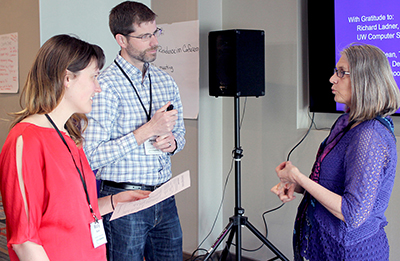
Workshop: Design Physics: Relationships
Led by Dan Formosa, Dan Formosa, Inc.
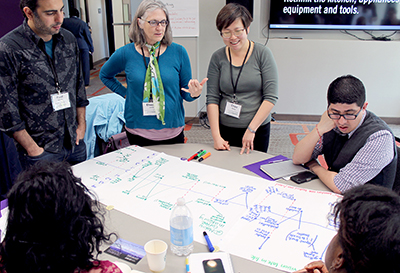
Almost every thing you touch throughout the day has been designed by someone, meaning a decision was made that influenced how it was made. Recently I went on a road trip, and I needed to find a place to eat. Yelp recommended this fantastic place called Daily Planet, with a great menu, which led me to wonder why I don’t make a tremendous breakfast at home regularly. What would it take me to make a great breakfast (Western omelette, bacon, home fries, toast, fresh orange juice, and coffee), and specifically, how would I make that if I had a specific disability?
I asked workshop participants to pick a specific disability and design a kitchen and tools to complete this task. Participants reacted to this experience in a variety of ways:
- If I cared about specifics, it was a lot harder—and it was more or less difficult based on my choice.
- It’s hard to design for someone when you don’t know their exact difficulties.
- When you solve for one problem, you can think of other people it could benefit and finding more solutions.
- Cultural differences can come up—for example, toast can be very different in different countries and may require different tools.
- There is a challenge that this can bring up even more universal design, and it can be hard to implement universal design because you realize you aren’t thinking about everyone when solving for one.
- If you solve for one problem, does that create another problem for another population?
- Sometimes a solution wouldn’t be used by everyone, and something may be inconvenient for one but a good solution for another.
CBI Participants
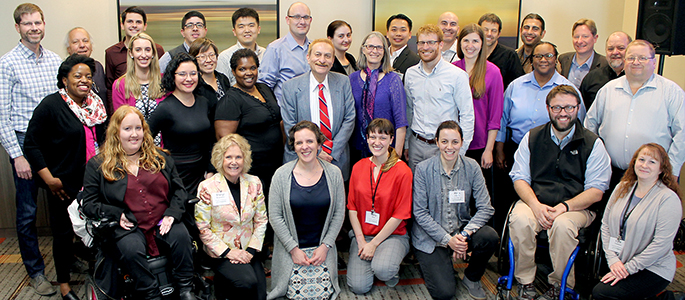
Stakeholder groups represented in the CBI included
- student service leaders and administrators,
- faculty members,
- students, and
- professional organizations.
The following individuals participated in the CBI.
Aceros, Juan
Professor Electrical Engineering
University of North Florida (UNF)
Blank, Molly
Lecturer
Bioengineering/University of Washington
Brooking, Gary
Engineering Educator
Wichita State University
Brown, Kayla
Program Coordinator, DO-IT
University of Washington
Burgstahler, Sheryl
Director, Accessible Technology Services (ATS)
AccessEngineering, PI
University of Washington
Cakmak, Maya
Assistant Professor
Computer Science & Engineering Department
AccessEngineering co-PI
University of Washington
Caspi, Anat
Director, Taskar Center for Accessible Technology
University of Washington
Crawford, Lyla
Program Coordinator, DO-IT
University of Washington
Cross, Kelly
Visiting Research Scientist
University of Illinois Urbana-Champaign
Dean, Jered
Teaching Associate Professor
Colorado School of Mines
Dusek, Jeff
Olin College
Farmosa, Dan
Designer
Dan Formosa, Inc.
Feldner, Heather
Postdoctoral researcher
University of Washington
Gess, Joshua
Assistant Professor
Oregon State University
Glasper Butler, Marilyn
Disability Services Coordinator
Georgia Tech
Hamidi, Foad
Postdoctoral Research Associate
University of Maryland, Baltimore County
Hayman, Doug
Senior Computer Specialist
University of Washington
James, Elianna
Adjunct Professor
University of Colorado - Boulder
Jiang, Zhaoshuo
Assistant Professor
San Francisco State University
Kabayadondo, Zaza
Co-Director
Smith College
Kamal, Ahmed
Associate Professor
Tennessee Tech University
Kramer, Howard
PI/Lecturer
University of Colorado Boulder
Lee, Elizabeth
Publications Coordinator, DO-IT
University of Washington
Liu, Li
Assistant Professor
California State University, Northridge
Mallouk, Kaitlin
Instructor, Tenure-Track
Rowan University
Manero, Albert
President/Director of Research Program Services
Limbitless Solutions/UCF
Mejia, Joel
Assistant Professor
Angelo State University
Ristvey, John
Director
University Corporation for Atmospheric Research
Russo, John
Dean, School of Science, Business and Technology
Landmark College
Seay, Jeffrey
Associate Professor
University of Kentucky
Shinohara, Kristen
PhD Candidate
University of Washington
Spingola, Elizabeth
Instructional Technology Support
Virginia Tech
Steele, Katherine
Assistant Professor, Mechanical Engineering
AccessEngineering co-PI
University of Washington
Svyantek, Martina
Graduate Assistant
Virginia Tech
Taylor, Alyssa
Senior Lecturer
University of Washington
Wang, Chao
Senior Lecturer, Engineering
Arizona State University
Communities of Practice
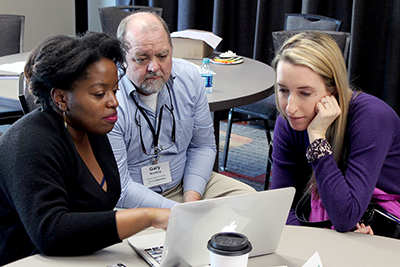
AccessEngineering staff and faculty leaders engage in an online community of practice (CoP) that includes key stakeholder groups that impact the success of students with disabilities in engineering programs (e.g., faculty, disability service units, online learning programs, veterans associations, career services, teaching and learning centers, diversity programs, professional organizations, employers) to share ideas and assist in the creation and dissemination of resources to encourage others to help a broader range of students pursue engineering fields and support them in their careers.
CoP members engage together:
- Share strategies for recruiting engineering faculty and administrators to participate in project activities.
- Share successful practices for recruiting students with a broad range of disabilities into engineering programs.
- Discuss how to engage, accommodate, and retain students with a wide range of disabilities in postsecondary engineering studies.
- Share disability-related and universal/accessible design content to be incorporated into senior design and other specific engineering courses.
- Learn about training videos, resources, and publications.
- Identify unmet needs and useful products for the project to develop.
- Provide input for a project video and related online resources.
- Respond to formative results of the project and suggest future activities.
- Share accessibility issues in their engineering courses and departments and brainstorm strategies for improvement.
- Explore strategies for adapting lab-based courses for universal/accessible design.
- Share forums for connecting students to engineers with disabilities in the local community and online.
- Discuss how robotic simulations and other technology can be used to improve access to hands‑on educational activities for individuals with disabilities.
- Collaborate in the development of universal/accessible design topics in conference presentations and seminar series.
Join AccessEngineering CoP by sending the following information to doit@uw.edu:
- Name
- Position/ Job Title
- Institution
- Postal Address
- Email Address
Resources
The AccessEngineering website contains
- information about project goals, objectives, activities, and project partners;
- evidence-based practices that support project goals and objectives;
- resources for students with disabilities; and
- educational materials for teachers and administration.
AccessEngineering maintains a searchable database of frequently asked questions, case studies, and promising practices related to how educators can fully include students with disabilities in computing activities. The Knowledge Base can be accessed by following the “Search Knowledge Base” link on the AccessEngineering website.
The Knowledge Base is an excellent resource for ideas that can be implemented in engineering programs in order to better serve students with disabilities. In particular, the promising practices articles serve to spread the word about practices that show evidence of increasing the participation and success of people with disabilities in engineering.
Below are examples of Knowledge Base case studies, promising practices, and questions:
- Conference Engagement via Robot: A Case Study in an Option for a Student Unable to Travel
- Collaboration Struggles in an Engineering Lab: A Case Study About a Student with Autism
- An Assistive Technology Course: A Promising Practice in Including Disability-Related Topics in the Engineering Curriculum
- ATHack: A Promising Practice in Promoting Accessibility Among Engineering Students
- Can people who have visual impairments work in a machine shop?
- How can engineering departments be welcoming and accessible to students with disabilities?
- How can I include people with disabilities in the broader impacts statement of my NSF grant proposal?
- Individuals and organizations are encouraged to propose questions and answers, case studies, and promising practices. Contributions and suggestions can be sent to doit@uw.edu.
For more information on AccessEngineering, universal design, and accessible STEM education, review the following websites and brochures:
- To learn more about and get involved with AccessEngineering, visit the website.
- To find more information on universal design, visit the Center for Universal Design website.
- For resources specifically designed for faculty, consult The Faculty Room.
- To learn how to create accessible engineering labs, departments, and makerspaces, review the following publications found at this website:
- Checklist for Making Engineering Labs Accessible to Students with Disabilities
- Equal Access: Universal Design of Engineering Departments
- Equal Access: Universal Design of Engineering Labs
- Making a Makerspace? Guidelines for Accessibility and Universal Design
- For proceedings from engineering-related capacity building institutes, visit the resources page.
Acknowledgments
AccessEngineering is funded by the National Science Foundation (EEC-1444961). Any opinions, findings, and conclusions or recommendations expressed in this material are those of the CBI presenters and project staff and do not necessarily reflect the views of the National Science Foundation.
DO-IT
University of Washington
Box 354842
Seattle, WA 98195-4842
doit@uw.edu
https://doit.uw.edu/
206-685-DOIT (3648) (voice/TTY)
888-972-DOIT (3648) (toll free voice/TTY)
206-221-4171 (FAX)
509-328-9331 (voice/TTY) Spokane
AccessEngineering Principal Investigators:
Sheryl Burgstahler, PI
Maya Cakmak, Co-PI
Katherine Steele, Co-PI
Brianna Blaser, Project Coordinator
Kayla Brown, Project Coordinator
© 2017 University of Washington. Permission is granted to copy this publication for educational, noncommercial purposes, provided the source is acknowledged.