
Audio Guides Across Europe
I’m DO-IT Ambassador Rochelle Bowyer. My first year as a DO-IT Scholar was 2016. This year I moved to Spain for a few months, learned some Spanish, and traveled to new places, which included several museums. While visiting these museums, I was able to use audio guides to make my museum visit more accessible and enjoyable.
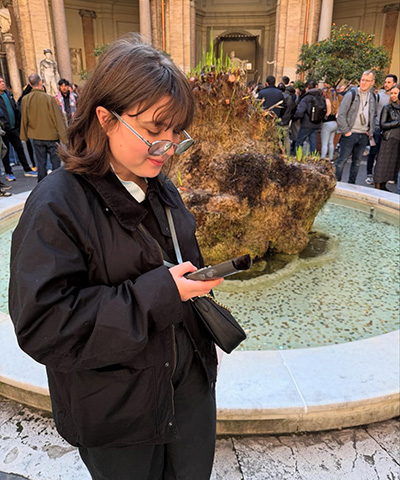
As someone who is neurodivergent, dyslexic, and has ADHD, I have a passionate love/hate relationship with museums. I love archaeology and history, fueled by the first books I successfully read on my own, like the Magic Tree House. Later in middle school, I read every biography and history-based text while everyone else was reading Harry Potter and the Warrior Cats series. So of course, I wanted to visit all the magical archaeology wonders that could be found in a museum and sparked my curiosity. But museums are not always the most manageable or accessible experiences for someone like me.
Even though I love museums and learning, it doesn’t mean that the museum experience is “easy” for me. I do not know if it is a me problem or the fact I have ADHD, but I can never follow a path. If left to my own devices, I will wander in all directions, causing me to be completely warn out before I even finish the museum. Sometimes I miss out on fun things because I got distracted by a thought that led me somewhere completely new. My other problem is that I find art museums somewhat boring, as I have never been passionate about small details of paint styles or brush strokes. However, traveling with a partner or anyone else means that you are not always going to the museums you love. This is where the importance of audio guides for my museum experience comes into play.
Audio guides are accessibility tools that I use to help combat the “chore” aspect of museums. Guides in general help ensure I stay on the correct path and not wander aimlessly. They allow my eyes to rest by giving me highlighted information for the exhibits, letting me choose if I want to dig deeper into the text or continue on to the next part of the exhibit. Lastly and most importantly, audio guides build context around things I might otherwise find uninteresting, so I can have a more enjoyable and slow-paced experience. In places like art museums, it allows my partner to take his time and enjoy his passions.
With such usefulness and effectiveness of audio guides in mind, I ranked my visits to various museums that I visited during my time in Europe. Please enjoy my commentary and rankings below, which I hope might give some guidance to others looking to plan their next museum trip.
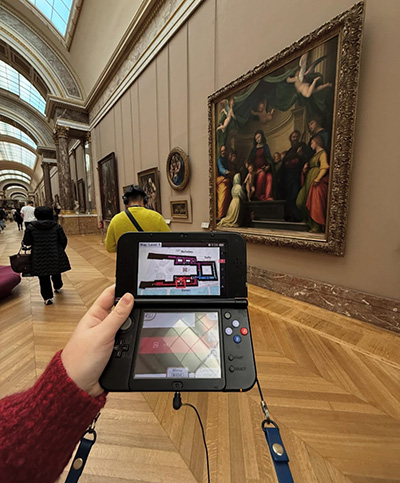
The Louvre, Paris – 4.5 stars
The Louvre earned a 4.5 because of its creativity. Their audio guide was downloadable onto a Nintendo 3D DS, which I found to be a cool and new experience. One of the best futures is that it has a location tracker. In such a giant museum, with a rather unclear museum path, this was very helpful, as the DS could tell you which audio guide numbers were nearby. The audio storytelling was done well, like a documentary; it would start in French and transition into your chosen listening language. I am taking away half a star because it had a hard learning curve to figure out how to use it, it was heavy to carry around, and I never truly got the hang of everything it could do, especially as someone who never played with a DS as a kid.
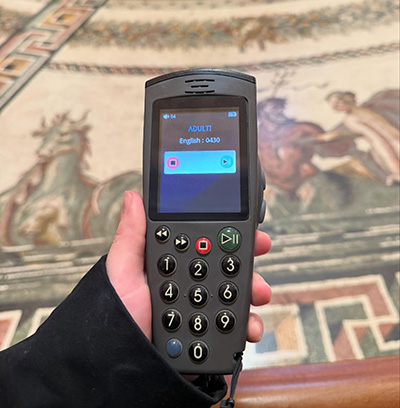
Vatican Museum, Vatican City – 3 stars
This museum’s audio guide was your classic audio guide, the one where you hold it to your ear like a phone. The learning curve on this one was very low; once you find the corresponding number you just type it in and press play. It is losing points, though, because I would rather use headphones and not hold something to my ear the entire time so l can instead focus on the piece I am observing. All in all, the Vatican Museum was not as creative as the Louvre, but was very user friendly (and had a lot of language options!).
Catacombs, Paris – 2 stars
The Catacombs also used the classic audio guide, but my user experience was a little worse than at The Vatican. It had a touch screen, which may sound like higher tech, but when you hold it up to your ear to listen, your hair or ear can sometimes accidentally tap the screen and stop the guide. When that happens, you have to re-listen to the guide, which can be annoying. This had the least amount of language options out of all the audio guides, but overall added to the experience.
Van Gogh Museum, Amsterdam – 3 stars
To be honest, I do not have much memory of this museum as my visit was two years ago, but my partner loves art while I think it is just something cool to look at for 10 seconds before I get bored and want to move to the next thing. So having an audio guide that tells me the story of the art piece and the history behind it is very helpful and makes me enjoy the experience better and for longer. I also liked that it had headphones and did not have to be held to my ear. But overall, nothing special.
La Sagrada Família, Barcelona – 5 stars
This was by far the best audio guide. Technically it was a free app you downloaded instead of physical audio guide you borrow from the museum. But it was an amazingly well-made app that was super accessible: you could use your own headphones, it was paired with photos in the app, it helped you re-center yourself if you were lost, and it had a transcript to go along with the audio. I know I already said it, but this was SO accessible and just amazing.
The Colosseum and Roman Forum – 1 star
I almost forgot about this one because of how bad the audio guide was. I was originally super excited because I found out it was an app and I loved the app-based audio guide in Barcelona. But it was not even close to being as good. The app was confusing to follow and once you had it downloaded you had to download extra content within the app for your “route” even though it was not clear which route you were even on. Since you needed to download the route, if you have bad reception, you are out of luck. I spent 30 minutes trying to get this app to work. Just because of my great experience in Barcelona, I once even tried deleting the app and redownloading it. In the end, I gave up, and experienced the Colosseum without one. To be honest, even though I read archaeology books for four years straight and was super excited to see something I had read so much about, it was kind of underwhelming and I wonder if it would have been different if I had a good audio guide. But the Roman forum was beautiful, audio guide or not. I could have spent hours there, if I was not so sleep deprived. Especially if I brought a book, a snack, and a reusable water bottle... it was so beautiful and peaceful. I did not see if there was a different guide for the Roman forum, but I loved it nonetheless.
