
Universally Designing Learning and Learning about Universal Design (2016)

Proceedings of the April 2016 AccessEngineering Capacity Building Institute (CBI)
This publication shares the proceedings of a capacity building institute (CBI) entitled Universally Designed Learning and Learning about Universal Design that took place in Seattle, Washington in April of 2016. The content may be useful for people who
- participated in the CBI;
- seek to increase their understanding of issues surrounding the participation of students with disabilities in engineering studies and careers;
- are interested in integrating information related to disability, accessibility, and universal design into their engineering courses;
- would like to access resources to help make their courses, services, and activities more welcoming and accessible to students with disabilities; and
- have promising practices to share with others.
About AccessEngineering
AccessEngineering works to increase the participation of people with disabilities in education and careers in engineering and improve engineering fields with their perspectives and expertise. Central to this work is a leadership team of faculty members from colleges and universities across the country. AccessEngineering is led by the College of Engineering and the DO-IT (Disabilities, Opportunities, Internetworking, and Technology) Center at the University of Washington (UW) and is funded by the National Science Foundation (Grant #EEC-1444961).
AccessEngineering builds on theory, research, and practice to address immediate challenges facing engineering education today, including: increasing the size of the engineering workforce, diversifying engineering fields, and meeting institutional obligations under the Americans with Disabilities Act of 1990 and its 2008 amendments. The project focuses on two objectives:
- Better serving a diverse student body that includes students with disabilities in engineering courses and programs
- Integrating relevant disability-related and universal design content into engineering courses
The second objective is an opportunity to improve engineering education as a whole, which may lead to the development of more accessible technology by the next generation of professional engineers, while including information in the engineering curriculum that may be of particular interest to potential engineering students, including students with disabilities.
About the CBI

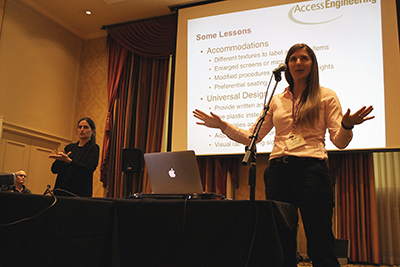
Universally Designed Learning and Learning about Universal Design in Engineering, sponsored by AccessEngineering, was held in Seattle, WA on April 5–8, 2016. Its purpose was to encourage efforts to make engineering more welcoming and accessible to students with disabilities and enhance engineering curricula with disability-related and universal design topics. Attendees included engineering students and professionals with disabilities, postsecondary faculty and administrators, disability experts, and professional organization representatives.
This CBI featured the following:
- All participants contributed to its success.
- Speakers participated in group discussions.
- Experts in all topic areas were in the audience.
- Participants gave presentations and participated in large and small group discussions.
- Some predetermined professional development was presented, new content was delivered as the meeting unfolded, and participant interests were expressed and expertise was made known.
The CBI provided a forum for discussing recruitment and access challenges, sharing expertise and successful practices, developing collaborations, creating resources, and identifying systemic change initiatives relevant to the meeting goals.
Topics discussed include
- universal design of laboratories, instruction, and academic accommodations;
- the experiences of engineering students and professionals with disabilities;
- outreach activities designed to recruit students with disabilities into engineering;
- best practices for making courses welcoming and accessible to students with disabilities; and
- inclusion of disability, accessibility, and universal design topics in engineering curricula.
The agenda for the CBI and summaries of the presentations, panels, and working group discussions are provided on the following pages.
CBI Agenda
Tuesday, April 5
7 – 9 pm
Networking Reception
Wednesday, April 6
8 – 9 am
Breakfast and Networking
9 – 10:20 am
Welcome, Overview, and Introductions
Sheryl Burgstahler, PI, and Katherine Steele and Maya Cakmak, Co-PIs, AccessEngineering, University of Washington (UW)
Video Drafts & Discussion of Possible Improvements
Broadening Participation in Engineering to Include People with Disabilities Including Accessibility and Universal Design in Engineering Curriculum
10:20 – 11 am
Accommodations and Universal (or Inclusive/Accessible) Design
Sheryl Burgstahler
11:15 am – 12:15pm
Panel of Engineering Students and Professionals with Disabilities
Panelists: Nicholas DiChiara, Auburn University, Marie Erickson, North Carolina State University, Kathryn Woodcock, Ryerson University, Daniel Stewart, University of Florida, Cynthia Bennett, UW
Moderator: Brianna Blaser, UW
12:15 – 1:15 pm
Working Lunch
Challenge: List specific examples of applications of universal design that could be integrated into engineering courses.
1:15 – 1:45 pm
Report Out
1:45 – 2:45 pm
Keynote: Universal Design in Project-Based Design Courses
Kimberly Bigelow, University of Dayton
3 – 3:30 pm
Small Group Discussion
How can you encourage instructors on your campus to consider integrating accessibility/universal design into their courses?
3:30 – 3:45 pm
Report Out
3:45 – 4:45 pm
Short Presentations – Human-Centered and Universal Design
Students’ Understanding of Human-Centered Design
Carla Zoltowski, Purdue University
Mentoring Engineering Students to Consider the Needs of Individuals who are Blind or Visually Impaired
Cris Schwartz, Iowa State University
EPICS: A Service-Learning Design Program
Andrew Pierce, Purdue University
Accessible Makerspaces
Katherine Steele and Maya Cakmak, UW
4:45 – 5:00 pm
Preview of Dinner Tonight and Tomorrow’s Topics
6 – 8 pm
Dinner
Discussion: How could engineering labs and makerspaces on your campus be made more accessible?
Thursday, April 7
8 – 9 am
Breakfast and Networking
9 – 9:15 am
Daily Overview, Discussion
9:15 – 10:15am
Keynote: Accessible Hands-on Learning
Bradley Duerstock, Purdue University
10:30 am – 12pm
Accessible Design Challenges
Cynthia Bennett and Andrew Davidson, UW
12 – 12:15pm
Introduction of Working Groups
Individually or in groups, draft promising practices, Q&A’s, or case studies for our knowledge base or replication packages; provide input on draft publications; or engage in discussions of key topics.
12:15 – 1:15pm
Lunch
Discuss with your working group what you hope to accomplish by the end of the meeting tomorrow.
1:15 – 1:45 pm
Report Out
1:45 – 3:15 pm
Continue Working in Working Groups
3:15 – 4 pm
Short Presentations – Outreach & Community Involvement
Providing Opportunities for K-12 Students with Disabilities to Engage in Engineering Activities
Leyf Starling, NCSU
Managing an Open Prototyping Facility
Davin Huston, Purdue University
Building a Cross-Campus Coalition Related to Disability
Jonathan Lazar
4 – 5 pm
Film: Fixed: The Science/Fiction of Human Enhancement
5 – 5:30 pm
Discussion
How do the viewpoints of the individuals in the documentary Fixed affect how you would teach about topics related to disability and universal design in the engineering curriculum?
Friday, April 8
8 – 9 am
Breakfast and Networking
9 – 9:15 am
Daily Overview
9:15 – 10:00 am
Panel: Supporting Students with Disabilities
Panelists: Brianna Blaser, UW; Jonathan Santeliz, Hispanic Association of Colleges and Universities; Dan Standage, Student Veterans of America; Cris Schwartz, Iowa State University
Moderator: Sheryl Burgstahler
10:00 – 11:15 am
Short Presentations: Disability-Related Issues in the Classroom
Preparing Individuals with Disabilities for Education and Work
Randy Williams, University of Pittsburgh
Lessons Learned from Teaching about Assistive Technology
Jeff Dusek, Harvard University
Examples of Student Projects related to Disability
Dave Chesney, University of Michigan
Creative Potential and Challenges of Students with ADHD in Engineering Programs
Arash Esmaili Zaghi, University of Connecticut
AT Hackathons
William Li, MIT
11:15 am – 12 pm
Working Groups
12 – 12:15 pm
Report Out from Working Groups
AccessEngineering Resources and Continuing Activities
Evaluation
12:15 – 1 pm
Lunch, Networking and Discussion
How can we continue to work together to promote universally designed engineering education and to encourage learning about universal design?
Presentation Summaries - Keynote Speakers
Accommodations and Universal (or Inclusive/Accessible) Design
Presenter: Sheryl Burgstahler
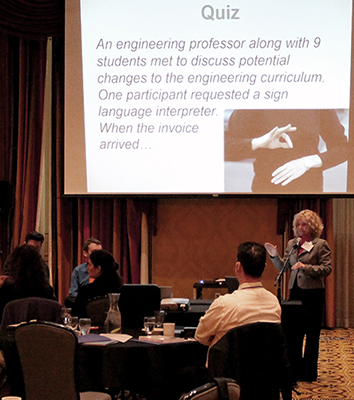
Ability exists on a continuum, where all individuals are more or less able to see, hear, walk, read print, communicate verbally, tune out distractions, learn, or manage their health. In K-12 education in the United States, every child is ensured a free, appropriate education in as integrated of a setting as possible. However, in postsecondary education, students must meet whatever course or program requirements apply and are offered reasonable accommodations as needed.
Accommodations and universal design (UD) are two approaches to access for people with disabilities. Both approaches contribute to the success of students with disabilities in engineering classes. Accommodations are a reactive process, providing access for a specific student and arise from a medical model of disability. Students might be provided with extra time on tests, books in alternate formats, note taker, sign language interpreters, or other adjustments.
In contrast, UD is a proactive process rooted in a social justice approach to disability and is beneficial to all students. UD is designing products and environments to be usable by all people, to the greatest extent possible, without the need for adaptation or specialized design. A UD approach can benefit people who face challenges related to socioeconomic status, race, culture, gender, age, language, or ability.
UD of instruction is an attitude that values diversity, equity, and inclusion. It can be implemented incrementally, focuses on benefits to all students, promotes good teaching practice, does not lower academic standards, and minimizes the need for accommodations. UD can be applied to all aspects of instruction, including class climate, interactions, physical environments and products, delivery methods, information resources and technology, feedback, and assessment. Examples include the following:
- Arranging seating so that everyone has a clear line of sight.
- Avoiding stigmatizing a student by drawing undue attention to a difference.
- Using large, bold fonts with high contrast on uncluttered overhead displays and speak aloud all content.
- Providing multiple ways to gain and demonstrate knowledge.
- Avoiding unnecessary jargon; defining terms.
- Providing scaffolding tools (e.g., outlines).
- Providing materials in accessible formats.
- Providing corrective opportunities.
- Testing in the same manner in which you teach.
- Minimizing time constraints as appropriate.
- Designing websites to include text alternatives for graphics, present context via text and visuals, include captions and transcripts for all video and audio content, ensure that all content and navigation can be reached with the keyboard alone, and spell out acronyms.
Educators who effectively apply UD and accommodations level the playing field for students with disabilities and make instruction welcoming to, accessible to, and usable by all students. They minimize, but do not eliminate, the need for accommodations.
Keynote: Universal Design in Project-Based Design Courses
Presenter: Kimberly Bigelow, University of Dayton
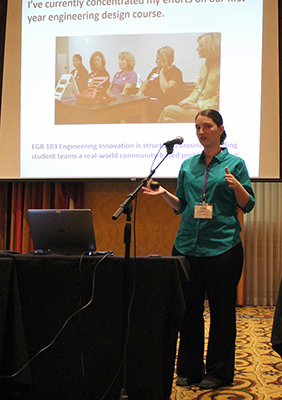
The presenter established the value of incorporating universal design into the engineering curriculum through the 7 guiding principles of universal design. These principles include Equitable Use, Flexibility in Use, Simple and Intuitive Use, Perceptible Information, Tolerance for Error, Low Physical Effort, and Size and Space for Approach and Use. Universal design is meant to make products, services, and environments more appropriate for the entire spectrum of abilities and preferences of users and should be considered in all engineering projects.
It is important to incorporate universal design principles into student design projects. If universal design isn’t incorporated into a design prompt or explicitly taught to students, they are unlikely to incorporate it into their designs in the course or in their future careers. This suggests that universal design is not inherently known, considered, or easily recognized by students. However, when a project was introduced that focused specifically on universal design and included some guided discussion and activities, students demonstrated the ability to understand and apply universal design principles fairly easily. It should be noted, though, that wheelchair accessibility was still considered more often and with more importance than the other guiding principles of universal design. Placing universal design in the student design prompt encourages students to research universal design and find new and interesting ways to incorporate it into their projects.
Factors can also come into play for students understanding and appreciating universal design. This starts with faculty awareness, and includes teaching some of the following:
- different types of objectives and constraints, such as “must use colors that have high visual contrast”
- different lessons on universal design and how it affects the design process
- diversity and different perspectives to the brainstorming and designing process
- how universal design affects a wide range of people, such as curb cuts aiding wheelchairs, carts, and strollers
Because faculty may not be aware of universal design, practitioners of universal design are encouraged to reach out to assist engineering faculty members. Individuals knowledgeable in universal design can start by offering guidance, support, and mentorship to faculty in engineering departments.
For more information on this topic, consult Bigelow, K.E. (2012). Designing for success: Developing engineers who consider universal design principles. Journal of Postsecondary Education and Disability, 25(3), 212 – 231.
Keynote: Accessible Hands-On Learning
Presenter: Bradley Duerstock
“It is a question of whether Society can afford to support such an enormous number of non-producers no matter how just their claim.... The injured man must be made to feel that he is not an object of charity, but that he is a handicapped contestant in the world of active people.” - Gilbreth and Gilbreth, 1917
There are a variety of reasons that people with disabilities are excluded from hands-on learning. Social stigmatization and attitudinal barriers like a lack of encouragement to study science, technology, engineering, and mathematics (STEM) fields, a lack of role models, little institutional support mechanisms for STEM labs, and difficulty in disseminating information and resources to those who need it all present challenges. So do physical barriers including the inability to use lab facilities and equipment, the inability to directly engage in lab research, and difficulty trying and acquiring assistive technology. As a result, people with disabilities are less likely to study STEM in graduate school and receive a PhD as their non-disabled peers.
At the Institute for Accessible Science, our mission is to promote the inclusion and active participation of persons with disabilities in science and engineering through practical training and research experiences, lab assistive technology (AT) and accessible scientific equipment, and enrichment and support services for both students and educators. We believe any person with a disability can pursue science and engineering as a career and that independence and practical STEM experiences are essential to success.
In our Accessible Biomedical Immersion Laboratory (ABIL), we’ve built an accessible wet lab. The lab “work triangle” consists of an accessible lab sink, fume hood, and an adjustable height lab-bench and ensured that safety devices are accessible. Current research looks at the following:
- Accessible scientific instruments and STEM-specific accessible technology. This includes remotely controlled tools, ways to make scientific instruments accessible, and strategies for sharing expensive lab equipment.
- Lab accessibility and safety. Users should consider aspects of both personal and environmental safety through contamination, disposal, and sanitation. Hands-free input modalities are great for reducing contamination.
- Disability simulation. Users can use our virtual reality tool to experience the lab from the perspective of someone who is standing, someone who is using a wheelchair, or someone who has tunnel vision to understand how it may be different to use the lab as a person with a disability.
- Virtual lab task training. This allows individuals with disabilities to simulate lab tasks via virtual reality.
- Lab ergonomic analysis. Labs should be reviewed to be as comfortable and accessible as possible.
In the future, 3-D printing can be used for customization and dissemination of STEM-specific AT. We need better methods for determining research accommodation solutions for students and federal funding is needed to promote the recruitment of students with disabilities in higher education.
For more on accessible hands-on learning, take a virtual tour of Ability360 (formerly ABIL).
Presentation Summaries - Short Presentations
Panel Presentation Summaries
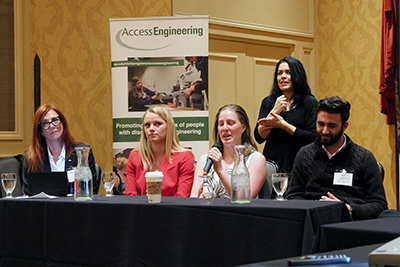
Panel: Engineering Students and Professionals with Disabilities
Panelists included Nicholas DiChiara, Auburn University; Marie Erickson, North Carolina State University; Kathryn Woodcock, Ryerson University; Daniel Stewart, University of Florida; and Cynthia Bennett, UW.
How has your disability impacted your education or your career?
- As a result of my learning disability, I took longer to get my degree and my grade point average was impacted, but that’s just something I look past. Since I was diagnosed in college, I spent a lot of time trying to figure out what it means to have a disability.
- As a blind person, no one ever told me I couldn’t do anything, but I often set limitations on myself. I chose a major, psychology, that I felt was easier to access than those heavier in math or science. I didn’t apply for internships because I was nervous about transportation. It wasn’t until after undergrad that I realized I didn’t have any skills to live independently. I took a course on living independently and gained more confidence to go to grad school.
- I often had a hard time obtaining a sign language interpreter, though sometimes I used Communication Access Realtime Translation (CART). I didn’t always know I was missing something if someone was turned away from me. I often didn’t get the chance to get to know my professors or teaching assistants and missed out on professional development. These barriers shaped my education and career.
What accommodations do you use and how do they affect your learning or career?
- I am blind and work with a reader who helps me take notes and get material converted to an accessible format. My reader would often help me make charts and graphs.
- I used a Livescribe pen and received extra time on tests. It has been difficult to get professors to outline their schedule at the beginning of the semester so that means it is hard for me to schedule private rooms with the disability services office to take my tests.
- Many of my older accommodations, like extended time on tests, weren’t applicable in my graduate lab—so it became more about me talking it out with others in the lab and finding out what would work best for me.
- Many of my classes are filmed and streamed online, which is very useful to me. I also test in a quiet place, though sometimes professors try to put me in office rooms with running copiers or bad lighting.
- It can be hard to get an ASL (American Sign Language) interpreter for small or sudden events. Being a guest lecturer is also difficult because I have to ask that they pay for an interpreter to come with me, which can be an awkward situation.
What do you wish educators and employers knew about accommodating students with disabilities?
- Don’t assume that just because someone has a disability that they do not have as much potential. People with disabilities are often more motivated to continue to work to show their potential or to follow a passion.
- Faculty often treat me like a chore and make negative comments about my accommodations or my disability. People should realize that I am a person and every person in a class has individual needs.
- Educators should remove bias from the way they teach and try to incorporate universal design into teaching methods. I had one teacher who typed as she talked and posted all the coding online before class. This really allowed me to follow along as the educator taught. Always teach like you will have a variety of students.
- As a professor myself, it can be hard to manage when I get multiple emails and letters telling me multiple accommodations. I wish the disability services office sent me one email with a list of all the people in my class, separated by what they needed per test or homework, etc. I also often use universal design in my teaching—and yet via these letters, I’ve had disability services demand I change the way I do something without even knowing all the details of how I teach or what is required.
- As a student, I hate the letters the disability services office asks I hand out—they are often filled with jargon and include accommodations I may not need in that class. I’d rather meet one-on-one with a teacher or TA to discuss what I’d need in the class.
- Disability and accommodation are sometimes a discussion of finding the best fit—in an atypical situation, like a research lab, it is much easier to talk about solutions and discuss how I can best use my skills rather than telling an educator or employer I can only work a specific way.
- Don’t be afraid to ask questions.
- There are multiple kinds of accessibility issues that faculty should think about. Some are technical (access to braille, captions, etc), others are logistical (extra time, interpreter, etc), and yet others are social (bias in groups, inequality, etc).
Cost of accessibility is always an issue, and people often judge an accommodation based on cost. What is your opinion on this?
- We need to reframe the issue to see that accommodations are just a normal cost of business rather than something special. Accommodations should be budgeted for. It’s great if it can come from a centralized budget. If the cost has to come from a departmental budget, it creates a disincentive for any particular department to be welcoming to individuals with disabilities.
- As someone with expensive accommodations (an ASL interpreter), I have to say, nobody else knows what I know. If people want my expertise, they have to pay for me to share that expertise with others. You can’t put a dollar value on someone’s input into a field or situation.
- We never look up the costs for other students’ equipment needs. We aren’t providing more for a student with a disability, we are providing them with equal access.
- Sometimes people with disabilities will get travel approval that doesn’t include travel expenses for a personal care attendant that they need for daily living activities—this ultimately means a person with a disability won’t be able to travel.
- It’s always hard to measure the cost benefit of an accommodation—it’s a much bigger picture than that. How do we include anyone on an every day basis? Everyone uses different tools and technology and all of these have costs.
The difference between K-12 and college is usually the type of support team a person has. What role does a TA play in helping or not helping?
- I know people who specify in their accommodations that they need personal time with a TA each week—I think this would be very beneficial, getting personal support from an expert in the class.
- I feel like TAs are very rarely taught anything about accessibility or disability. This and their busy schedules make it hard to get them on board for universal design or accommodations.
- I personally don’t think TAs should be involved with my accommodations—they don’t usually know the rules and it is a lot of responsibility to put on a TA who is ultimately at the university for their own education and not mine.
Panel: Supporting Students with Disabilities
Panelists included Brianna Blaser, UW; Jonathan Santeliz, Hispanic Association of Colleges and Universities; Dan Standage, Student Veterans of America; and Cris Schwartz, Iowa State University.
How do you promote people with disabilities getting jobs and promotions in the federal government? Is there a gap between people with disabilities at lower level and higher-level positions within the government or other companies?
- This event has given me more strategies for some of these issues. We have retention issues at our agency, where people will get hired but then not supported. Sometimes people hired will feel like an outsider if they’re the only person who is a minority.
- Recruitment is often focused on in the hiring process, while retention and career building are usually overlooked.
Is there any work on helping people with disabilities learn leadership skills, advocacy, and other similar skills that help individuals build their career?
- We work one-on-one with students to make sure they learn leadership and self-advocacy skills.
- We need to frame advocacy as part of the larger institutional change. Students should be involved in the change going on around them and part of the campaign to make those changes.
- My institution doesn’t have anything organized for these efforts—everything we do is usually reactive instead of proactive.
What is your experience with veterans on campus and their specific challenges? How do you bring disability into that conversation?
- Anyone recruited to the military gets screened for a disability, and a lot of veterans often have physical or mental disabilities. However, veterans are usually not trained in how to focus on school work, creating resumes, or advocating for themselves, and because of this, almost 50% drop out. We need to teach veterans that they have more resources out there, including mentoring, tutoring, and career building.
- We need to make sure that disability isn’t seen as a negative, but just a difference, and show veterans and all students that support is out there for people with disabilities.
Working Group Discussion Summaries
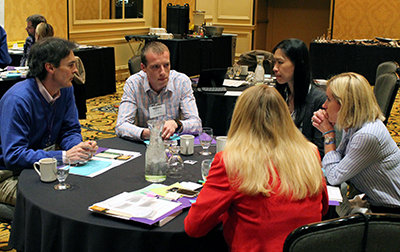
Discussion points made during group collaboration are presented below.
List specific examples of applications of universal design that could be integrated into engineering courses.
- Include instruction on accessible design in engineering lab courses and ask a wide variety of people for input on lab design.
- Create videos that define engineering and show how universal design can be incorporated into engineering projects and programs.
- Add multiple modes of assessment to courses, including visual, auditory, and kinesthetic options. Allow assessments to be more open ended and without time limits.
- Develop an accessibility/universal design rating system for courses.
- Create guidelines or standards for courses that include universal design.
- Help students develop empathy for disability by inviting a panel of people with a variety of abilities to discuss their experiences and include people with disabilities in project testing.
- Have more student-led discussion and interactive methods for learning and assessment instead of just sit-down learning.
- Create opportunities for students to meet the user and work with them to create a project—include people with disabilities in these scenarios.
- Cite examples of where universal design works better than products without universal design.
- Create websites and curriculum that are accessible and usable by everyone.
- Develop strategies to support students based on individual needs.
- Include a variety of accessible equipment in engineering labs, including auto-open trash cans, doors, and faucets; kitchen tools; digital and print materials; and other tools based on individual needs.
- Incorporate scaffolding for notes and projects and include ideas for how to move forward with projects.
- Let students speak for themselves and their own abilities—don’t make assumptions or just listen to disability services.
- Have students discuss about real world examples of technology and who is being included and excluded in multiple examples.
How can you encourage instructors on your campus to consider integrating accessibility/universal design into their courses?
- Get company buy in to demonstrate to instructors that the need is out there for accessible products.
- Give a faculty member a promotion to head an access board or lead an accessible engineering program.
- Create quick and easy tutorials on accessibility, accessible documents, and captions for staff and faculty to review.
- Allow faculty to have a “mini sabbatical,” where they can spend time revamping their syllabus and including universal design.
- Offer paid seminars and workshops on universal design for faculty to attend.
- Have the IT department do website reviews and address issues with faculty.
- Incorporate accessibility into instructors’ annual review.
- Have faculty peer review each other’s material with a focus on accessibility.
- Discuss personal connections to disability and commonalities with disability.
- Create a rewards program for those who can meet criteria created around universal design.
- Create a center for accessibility that can be used as a resource on campus.
- Create resources about universal design and accessible documents that can be used freely by all instructors and accessed online from the school website.
- Share case studies and promising practices from the DO-IT website with instructors.
- Leverage existing infrastructure and disability services to provide support for UD.
- Get Ivy League institutions on board with universal design and accessibility to encourage smaller institutions to follow suit.
- Require all professors to discuss current research and industry applications, and encourage professors and students to both bring up the topic of universal design and incorporate it into engineering curriculum.
- Create more incentive for diversity in engineering departments.
- Implement EPICS on more campuses.
- Encourage accessibility and UD as a standards level from the National Academy of Engineering, ABET, and the National Science Foundation.
How could engineering labs and makerspaces on your campus be made more accessible?
- Get adjustable equipment racks and tables, as well as other universally designed equipment that allows for more people to participate.
- Try to use updated infrastructure for engineering labs and makerspaces so all students can access the rooms.
- In research labs, encourage a buddy system where experiments are done in pairs or groups, where people with disabilities fill a role suited to their strengths.
- Include education on disabilities, accessibility, and inclusivity in classes and lab spaces.
- Collaborate with other stakeholders across campus. Bring administration into the discussion so they can see who is being affected and why money for universally designed space and equipment is important.
- Put tags on equipment and have permanent homes for them so people with visual impairments can find these items easier.
- Add velcro or other textures on buttons for tools so there is tactile feedback.
- Make sure all manuals and equipment is well organized.
- Recruit and include students and faculty with disabilities in the design process.
- Have workshops that can be inclusive by holding them in accessible spaces and having a variety of ways to participate.
- Provide a map to students of a lab space, so they know where tools are right away. Allow for an accessible digital version of this map.
How do the viewpoints of the individuals in the documentary Fixed affect how you would teach about topics related to disability and universal design in the engineering curriculum?
- People with disabilities—even people with the same disability—have a broad spectrum of opinions about their disability, and one person should not be considered a spokesman for everyone.
- We need to change the view from “fixing people” to “fixing the environment” and look at how engineering can work to make an environment accessible to the greater group.
- The social justice perspective of disability has a place in the discussion. Engineering often relies on the medical model of disability as something to be fixed—not everyone wants to be fixed but instead may want different types of tools. We should redefine what is normal and what is expected.
- We will add information about diversity as an aid to the human perspective.
- I plan to craft an engineering ethics class that involves this documentary.
- Fixed mainly talked about visible disabilities—I would be interested in seeing this perspective on people with invisible disabilities as well and how our classes can bring invisible disabilities into engineering curriculum.
- This documentary reinforces the idea that users are not homogeneous and all users should be treated as individuals.
CBI Participants
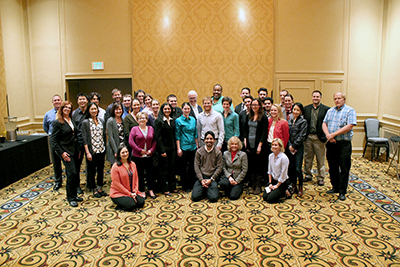
Stakeholder groups represented in the CBI included
- student service leaders and administrators,
- faculty members,
- students, and
- professional organizations.
The following individuals participated in the CBI.
Admoni, Henny
Postdoctoral Fellow
Carnegie Mellon University, Robotics Institute
Anand, Ramona
Project Manager/ Adjunct faculty
Lorain County Community College
Anderson, Susan
Adjunct Faculty, Humanitarian Engineering Program
Colorado School of Mines
Bennett, Cindy
Graduate Student, Human Centered Design and Engineering
University of Washington
Bigelow, Kim
Associate Professor
University of Dayton
Blacklock, Jenifer
Assistant Department Head
Colorado School of Mines
Blaser, Brianna
Program Coordinator, AccessEngineering
University of Washington
Bowen, Anna
3D Printing Lab Manager
Purdue University
Burgstahler, Sheryl
Director, Accessible Technology Services (ATS);
PI, AccessEngineering
University of Washington
Cakmak, Maya
Assistant Professor, Computer Science and Engineering;
Co-PI, AccessEngineering
University of Washington
Cardona, Andres
Research Engineer
Rehabilitation Institute of Chicago
Chesney, David
Faculty
The University of Michigan
Choi, Young Mi
Assistant Professor
Georgia Institute of Technology
Crawford, Lyla
Program Coordinator
DO-IT, University of Washington
Crippen, Marvin
Senior IT Specialist, DO-IT
University of Washington
Dean, Jered
Teaching Associate Professor
Colorado School of Mines
DiChiara, Nic
Software Engineer
Auburn University
Duerstock, Brad
Associate Professor of Engineering
Purdue University
Dusek, Jeff
Postdoctoral Fellow
Massachusetts Institute of Technology and Harvard University
Erickson, Marie
Undergraduate Student
North Carolina State University
Zaghi, Arash Esmaili
Assistant Professor
University of Connecticut
Fender, Meredith
Senior Manager, Component Collaboration and Resources
American Institute of Architects
Gibson, Ryan
Senior Design Engineer
Boeing
Goldschmid, Josh
Program Manager
Boeing
Gulamali, Faris
Research Assistant
Orthocare Innovations
Harkness, William
Enterprise Domain Engineer
Boeing
Hayman, Doug
IT Specialist, DO-IT
University of Washington
Huston, Davin
Clinical Assistant Professor
Purdue University
Jaramillo, Giselle
Research Engineer
RIC
Jose, Sharon
Neural Engineering Programmer
George Mason University
Krehbiel, Steve
IT Manager
URAC
Lan, Mei-Fang
Clinical Assistant Professor/Psychologist
University of Florida
Larsen, Kyle
Assistant Professor
Eastern Washington University
Lazar, Jonathan
Professor of Computer and Information Sciences
Towson University
Li, William
PhD Student
Massachusetts Institute of Technology
Neff, Britt
Counselor Servies Coordinator
University of Washington
Perkins, Annuska
PhD Student
University of Washington
Pierce, Andrew
Laboratory Manager
Purdue University EPICS
Reissman, Timothy
Postdoctoral Fellow
Northwestern University / Rehabilitation Institute of Chicago
Santeliz, Jonathan
Executive Director, HACU National Internship Program (HNIP)
Hispanic Association of Colleges & Universities (HACU)
Schwartz, Cris
Associate Professor
Iowa State University
Sharma, Ritu
Professor
Bryant Stratton College
Shinohara, Kristen
PhD Candidate
University of Washington
Simmons, Chelsey
Assistant Professor
University of Florida
Smith, Michael
Deputy Exec. Director / Diversity Council Chair
The National GEM Consortium / DiscoverE
Standage, Dan
Director, Disability in Education
Student Veterans of America
Starling, Leyf
Program Coordinator
NC State University
Steele, Katherine
Assistant Professor, Mechanical Engineering
Co-PI, AccessEngineering
University of Washington
Stewart, Daniel
Graduate Student & Researcher
University of Florida
Taylor, Alyssa
Full-time Lecturer
University of Washington
Williams, Randy
Lead Education and Outreach Coordinator
University of Pittsburgh
Woodcock, Kathryn
Associate Professor
Ryerson University
Wu, Chang-Yu
Professor and Department Head
University of Florida
Ziegler, Mary
Program Manager for Online Accessibility
Massachusetts Institute of Technology
Zoltowski, Carla
Co-director
Purdue University/EPICS
Zuo, Wei
Instructional Consultant
Center for Teaching and Learning
Community of Practice
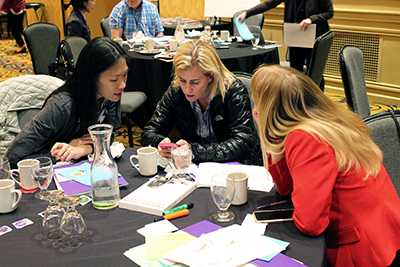
AccessEngineering staff and faculty leaders engage in an online community of practice (CoP) that includes key stakeholder groups that impact the success of students with disabilities in engineering programs (e.g., faculty, disability service units, online learning programs, veterans associations, career services, teaching and learning centers, diversity programs, professional organizations, employers) to share ideas and assist in the creation and dissemination of resources to encourage others to help a broader range of students pursue engineering fields and support them in their careers.
CoP members engage together:
- Share strategies for recruiting engineering faculty and administrators to participate in project activities.
- Share successful practices for recruiting students with a broad range of disabilities into engineering programs.
- Discuss how to engage, accommodate, and retain students with a wide range of disabilities in postsecondary engineering studies.
- Share disability-related and universal/accessible design content to be incorporated into senior design and other specific engineering courses.
- Learn about training videos, resources, and publications.
- Identify unmet needs and useful products for the project to develop.
- Provide input for a project video and related online resources.
- Respond to formative results of the project and suggest future activities.
- Share accessibility issues in their engineering courses and departments and brainstorm strategies for improvement.
- Explore strategies for adapting lab-based courses for universal/accessible design.
- Share forums for connecting students to engineers with disabilities in the local community and online.
- Discuss how robotic simulations and other technology can be used to improve access to hands-on educational activities for individuals with disabilities.
- Collaborate in the development of universal/accessible design topics in conference presentations and seminar series.
Join AccessEngineering CoP by sending the following information to doit@uw.edu:
- Name
- Position/ Job Title
- Institution
- Postal Address
- Email Address
Resources
The AccessEngineering website at contains
- information about project goals, objectives, activities, and project partners;
- evidence-based practices that support project goals and objectives;
- resources for students with disabilities; and
- educational materials for teachers and administration.
AccessEngineering maintains a searchable database of frequently asked questions, case studies, and promising practices related to how educators can fully include students with disabilities in computing activities. The Knowledge Base can be accessed by following the “Search Knowledge Base” link on the AccessEngineering website.
The Knowledge Base is an excellent resource for ideas that can be implemented in engineering programs in order to better serve students with disabilities. In particular, the promising practices articles serve to spread the word about practices that show evidence of increasing the participation and success of people with disabilities in engineering.
Examples of Knowledge Base case studies, promising practices, and questions include
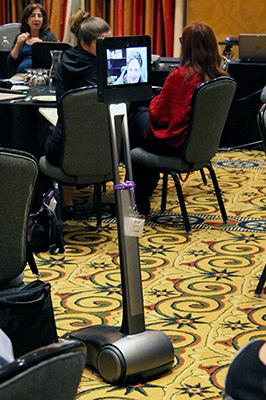
- Conference Engagement via Robot: A Case Study in an Option for a Student Unable to Travel
- Distance Learning: A Case Study on the Accessibility of an Online Course
- Emerging Leaders Program: A Promising Practice in Placing College Students with Disabilities in Challenging Internships
- Hosting a Panel of Students with Disabilities: A Promising Practice in Raising Awareness of Disability Issues
- Are electronic whiteboards accessible to people with disabilities?
- Are there scientific and graphing calculators that can be used by students who are blind?
Individuals and organizations are encouraged to propose questions and answers, case studies, and promising practices. Contributions and suggestions can be sent to doit@uw.edu.
For more information on AccessEngineering, universal design, and accessible STEM education, review the following websites and brochures:
- Learn more about and get involved with AccessEngineering.
- Find more information on universal design by visiting the Center for Universal Design website.
- Consult The Faculty Room for resources specifically designed for faculty.
- To learn how to create accessible engineering labs, departments, and makerspaces, review the following publications:
Acknowledgments
AccessEngineering is funded by the National Science Foundation (EEC-1444961). Any opinions, findings, and conclusions or recommendations expressed in this material are those of the CBI presenters and project staff and do not necessarily reflect the views of the National Science Foundation.
DO-IT
University of Washington
Box 354842
Seattle, WA 98195-4842
doit@uw.edu
www.washington.edu/doit
206-685-DOIT (3648) (voice/TTY)
888-972-DOIT (3648) (toll free voice/TTY)
206-221-4171 (FAX)
509-328-9331 (voice/TTY) Spokane
AccessEngineering Principal Investigators:
Sheryl Burgstahler, PI
Maya Cakmak, Co-PI
Katherine Steele, Co-PI
Brianna Blaser, Project Coordinator
© 2016 University of Washington. Permission is granted to copy this publication for educational, noncommercial purposes, provided the source is acknowledged.