
The Exciting World of 3D Printed Assistive Technology
Users of 3D printers have become increasingly creative as the technology becomes more user-friendly, available, and affordable. Among their many creative pursuits include home-spun assistive technology (AT) devices! This article shares some examples of 3D AT that staff learned about at a recent workshop hosted by a group called Roots2Wings.
Examples from the Washington Assistive Technology Act Program (WATAP)
WATAP provides resources and services on assistive technology (AT) for work, school, home, and leisure. They are located at the University of Washington (UW), and their work is supported by the Administration for Community Living and other funding.
In addition to lending Assistive Technology to Washington State Residents, they offer 18 different Assistive Technology items that are 3D printed. Individuals can request up to five (5) items, and they will 3D print them and ship them to you, at no cost. Staff favorites include the following.
- The Signature Guide is a Writing aid with five different sized openings that help people to write in a specific area on a print document.
- The XBox Adaptive Thumbsticks are for people who can't use the typical Xbox controller thumbstick.
- Ring Fidget Spinners are three concentric rings, just loose enough that you can move each ring individually. The outside diameter of the ring is a little bigger than a quarter and is about 1/2 inch thick. They are small so you can discreetly keep one in your hand.
- The Touch Mapper is a tactile map, typically used by a person with low vision or who is blind, that allows people to use touch to identify key elements such as sidewalks, paths, locations, and obstacles.
An example of Collaboration with the UW Employment Program
The UW's Employment Program demoed communication or sequencing bracelets made using 3D printers. They partner with WATAP and a UW student club called Woof3D to create these items for their participants. The communication bracelets use a flexible band and have square, clip-on beads with icons, representing words or phrases. The bracelets are small and more discrete than a communication board or device. The custom beads on the sequencing bracelets represent tasks. The user can then communicate and/or remind themselves about certain key tasks as they go about their day.
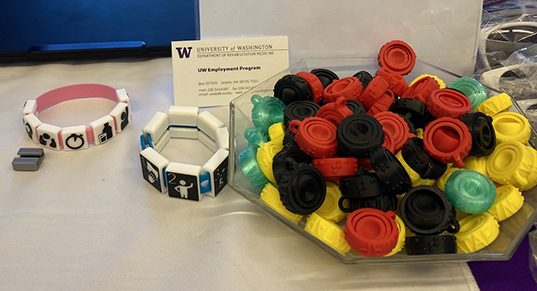
The photo above is from the Roots2Wings workshop and shows two communication bracelets as well as a bowl full of fidget rings, in either green, yellow, black and red. Some have a loop which can be used to hook them to a keyring or lanyard. There is also a business card from UW Employment Program.
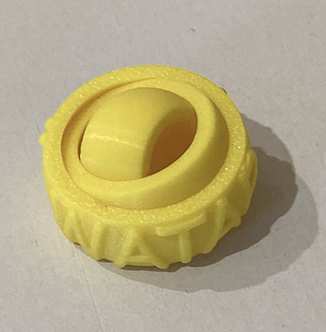
This photo above is a close-up of a yellow fidget ring. It is a spinner made up of three concentric rings, that are loose enough to rotate independently of each other. The ring has the letters WATAP engraved on the outside ring and is about the diameter of a quarter.