Evaluation
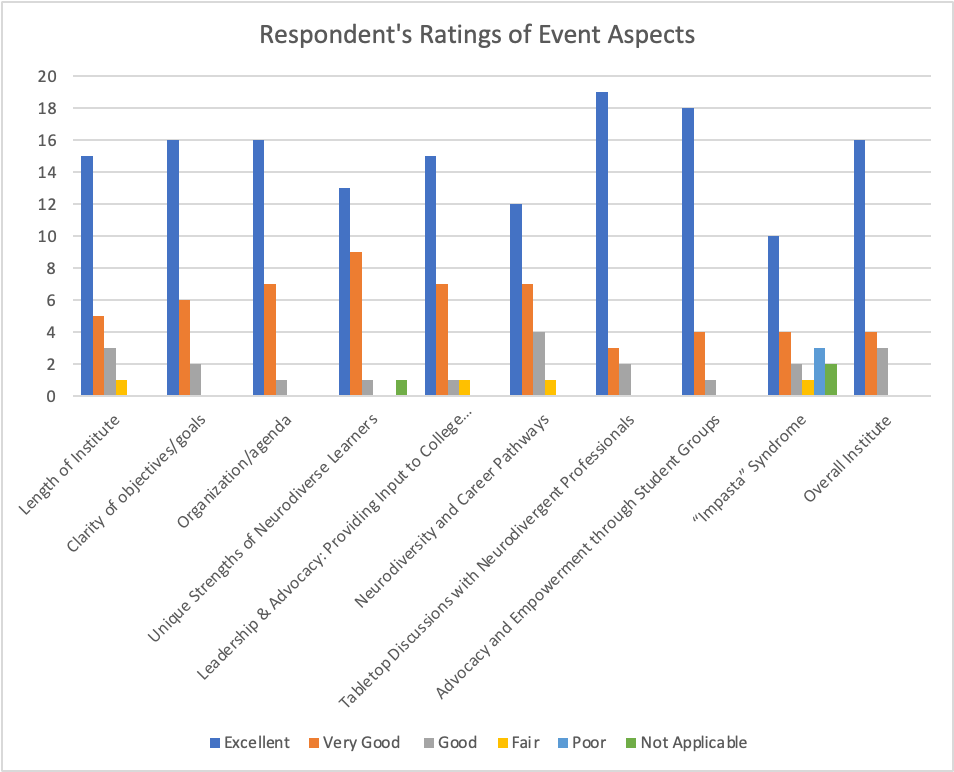
At the conclusion of the event attendees were asked to rate aspects of the event using a scale of Excellent, Very Good, Good, Fair, Poor, and Not Applicable. The chart below shows that the majority of respondents rated every aspect of the conference as Excellent with Very Good being the second highest rating for each aspect.
Respondents were also asked to answer a series of open ended questions about the event. When respondents were asked “As a result of attending this institute how has your knowledge and/or ability to elevate the voices of neurodivergent students pursuing STEM changed?” Examples of responses included:
- My perspective of neurodivergence was greatly impacted by getting to know so many other neurodivergent students in STEM. The institute made me feel like my voice was being heard and my input mattered. I want to be able to make neurodivergent students at my university feel the same way.
- I have learned so many new things about how to advocate for myself and others at my university. This institute has been so helpful to meet others who have similar experiences as myself. I feel a lot more confident about taking what I have learned and sharing it with my campus to help elevate their voices.
- I now understand a lot more about the inner-workings of advocacy and feel empowered to continue on my own journey to support our community.
- I am encouraged to reinvent the way I see myself and to lean into my natural characteristics that I normally tend to mask. Being able to see that there are different strengths neurodivergent people have places a value on them instead. Finding the setting to utilize those natural talents is something I want to focus on to help myself and others find their places and passions in STEM.
- I feel much more confident in pursuing stem and higher education as a neurodivergent student, and I feel like more and more resources are being made available to me.
Students were asked to share one specific action they plan to take as a result of something they learned at this event. Responses included plans to learn more about disability history and theory (1), increasing advocacy on campus (1), creating or joining a campus group for students with disabilities (5), promoting faculty training or asking for more help from faculty (3), developing a list of helpful resources for use personally or on campus (2), advocacy at the state level for more inclusive postsecondary environments (1), helping expand or enhance existing programs such as TAPDINTO-STEM (1), applying for additional graduate studies (1), building their network of supports and fellow advocates (2), and increased advocacy for the employment of neurodivergent individuals (1).
When asked which aspects of the event were the most useful to them, responses talked about the value of in-person networking, learning about advocacy, and the diversity of topics. One student shared “I really loved all the sessions! I loved finally finding my people, I’ve never felt so safe and accepted. I didn’t feel like I had to mask or dial myself up or down for the event. It was really an eye opener for me to realize. I appreciated that we were all at different stages of either our education or our career but all were neurodivergent.” Another student commented “All aspects of the institute were immensely useful to me. I have learned so much not only about myself as an academic, but as a human being, and I feel so much more confident navigating the world around me and being unapologetically myself. The panelists, speakers, physical media, and online resources were immensely helpful and these speakers have opened my eyes to my own personal strengths as a neurodivergent individual. I don't have to be insecure, I can work my personal identity to my advantage and it's okay to be different.”
Students were asked if they had suggestions for making a future event like this more useful. Responses included the following: including an in-depth presentation at the outset related to disability history and theory, adding more breaks and opportunities to move around to more locations, extending the institute (such as adding an extra day), including information about grant writing, and receiving the agenda earlier.